Scary Stories for Kids: 6 Spooky Tales That Won’t Cause Nightmares
Six original spooky stories for kids aged 7 and up, each about three minutes read aloud, with gentle twists and happy endings, plus tips for telling them.

Four more original spooky-not-scary stories for kids aged 6 to 10: moving stars, an overdue library book, a waving scarecrow and a playful shadow.
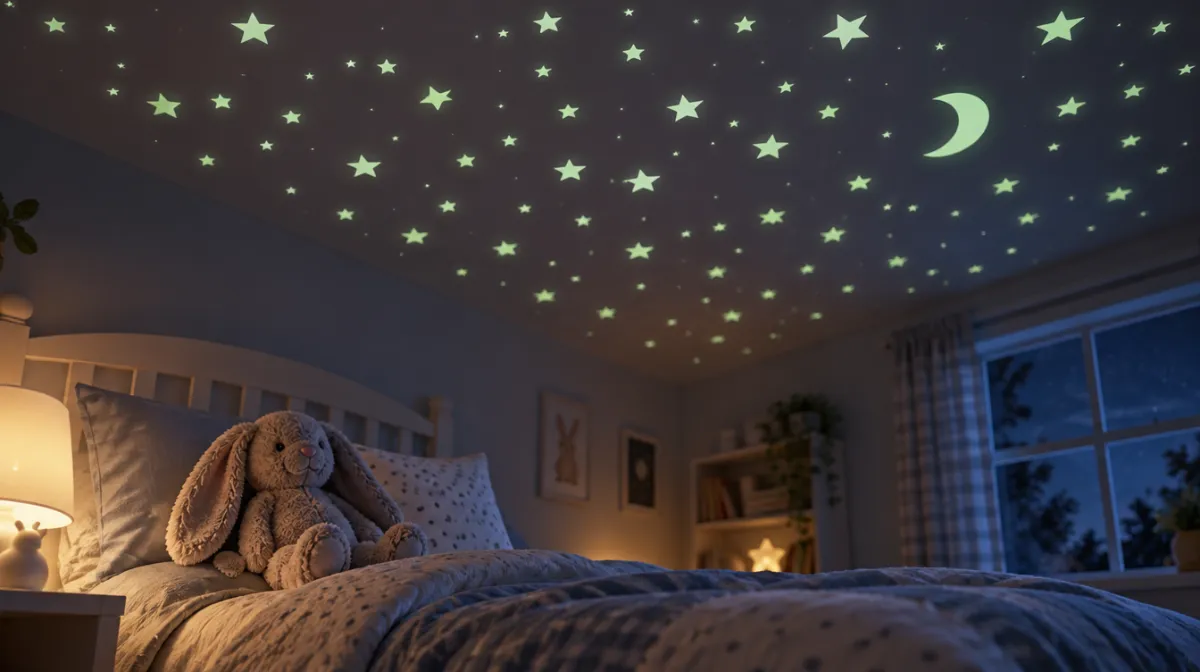
These four stories are made for reading aloud to younger children: a shiver in the middle, a smile at the end. They’re a follow-up to our first collection of scary stories for kids.
Noah had a hundred glow-in-the-dark stars on his bedroom ceiling. He knew exactly where each one was, because he’d stuck them there himself, standing on his bed with Dad holding his ankles.
One night, when the lights went out, the stars were in the wrong places.
Noah pulled the blanket up to his nose. Slowly, silently, the stars slid across the ceiling, gathering together into a shape.
It was a smile. A huge, glowing, friendly smile.
Then the stars rearranged themselves again, into three words: GOOD NIGHT NOAH.
Noah smiled back. “Good night,” he whispered.
In the morning, the stars were back where they belonged. Except one, which was stuck on his pillow, right next to where his head had been.
The note in the library book said: Please return by October 31, 1924.
“That’s a hundred years overdue,” said Ruby. “The fine must be enormous.”
She took it back anyway. The library was quiet, and a very old librarian with silver hair and round glasses was sitting at the desk. Ruby had never seen her before.
“Thank you, dear,” the librarian said, taking the book. “I’ve been waiting for this one for a very long time. Nobody ever finishes the last chapter.”
“I did,” said Ruby. “It was the best part.”
The librarian beamed, stamped Ruby’s hand with a tiny gold star and faded away like mist on a window.
The star on Ruby’s hand stayed there for a whole week, even through bath time.
Every day on the way to school, Leo passed a scarecrow in Mr. Patel’s field. Every day, Leo waved.
One windy morning, the scarecrow waved back.
Leo stopped. The scarecrow stopped. They looked at each other for a long time.
The next day, Leo waved again, and the scarecrow waved again. By Friday, the scarecrow was giving him a thumbs-up.
On Saturday, Leo told Mr. Patel. Mr. Patel laughed. “That old scarecrow doesn’t even have a thumb,” he said.
But when they walked out to the field together, the scarecrow was holding a single sunflower, bent towards Leo like a present. Mr. Patel went very quiet. Then he picked the sunflower and handed it over.
“I think,” he said, “you’ve made a friend.”
Mia’s shadow started acting strangely on a Tuesday. When she jumped, it jumped a little higher. When she spun, it spun twice.
On Wednesday, it waved at her from the wall when she wasn’t waving at all.
Mia wasn’t scared. Well, not very. “What do you want?” she asked it.
The shadow pointed at the garden, where the sun was setting and all the other shadows were long and stretchy and playing on the grass.
“You want to play?” Mia asked. The shadow nodded.
So they played shadow tag until it got dark, and when Mom called Mia in for dinner, her shadow followed her, walking just a little bit happier than before.
If spooky stories make bedtime harder, a steady routine helps; BratChild explains how to build a bedtime routine that works. For older kids ready for a bit more, try our scary stories for sleepovers.
They’re written for children aged about 6 to 10, with gentle spooky moments and happy endings.
They’re designed to be comforting, not frightening. Every child is different, so read them first if you’re unsure.

Every article is edited by a human and checked against our editorial policy. Spotted a mistake? Tell us.
Six original spooky stories for kids aged 7 and up, each about three minutes read aloud, with gentle twists and happy endings, plus tips for telling them.
Three original scary stories for sleepovers, spooky but not nightmare fuel, with tips for telling them by flashlight and landing the jump at the end.
Thirty original two-sentence horror stories, from quietly unsettling to properly chilling, plus how the format works and tips for writing your own.