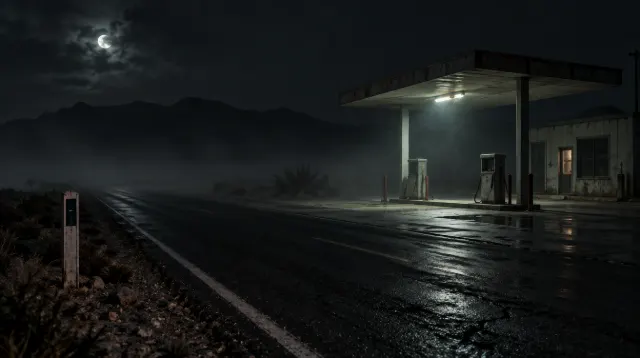
The Night Shift at Mile 49
A night clerk at a lonely desert gas station learns why the shift at Mile 49 pays double. An original short horror story for teens and adults.

An original short horror story: on the last run of the night, a bus driver picks up a passenger at a stop that was removed years ago.
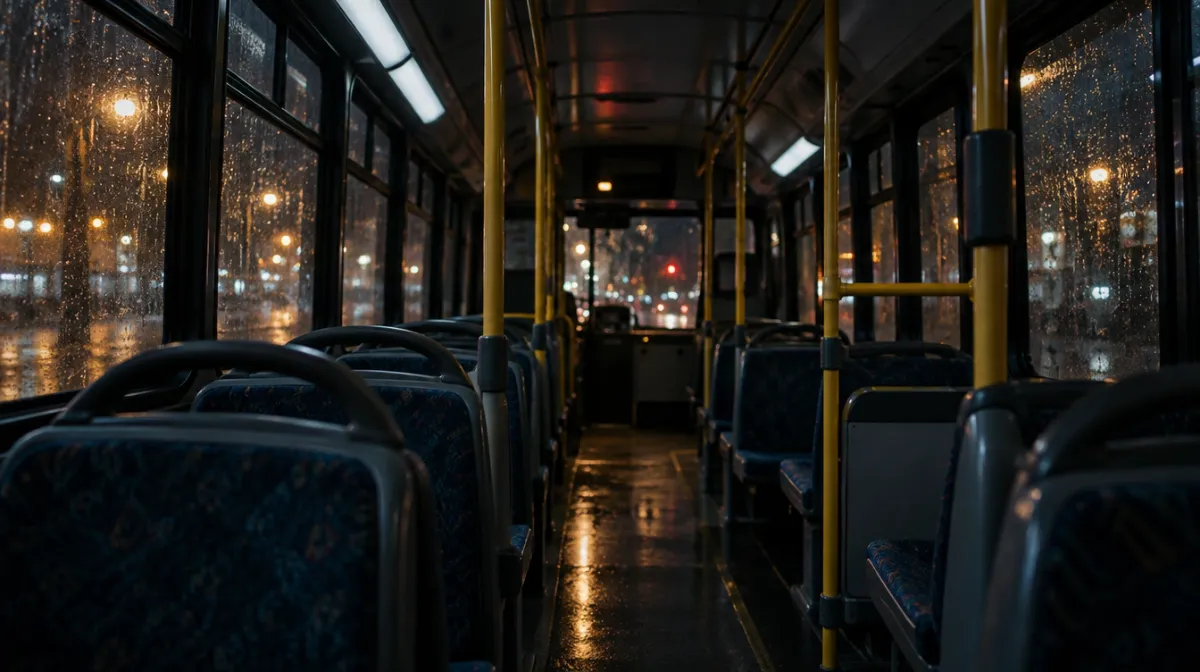
Ray had driven the 44 for nineteen years, and the last run of the night was the one he liked best. Empty streets. Green lights all the way. The heater ticking and the wipers keeping time.
It was raining hard when he passed the corner of Hollow Lane, which was why he almost didn’t see her.
There hadn’t been a stop on Hollow Lane since the route changed, back when Ray was a new driver. The shelter was long gone. But there she was under the streetlight, a young woman in a yellow raincoat, one arm raised.
Ray stopped. He always stopped for someone in the rain.
She climbed aboard, dripping, and dropped something into the fare box. It rattled the way nothing had rattled in years. Ray glanced down. A brass token, the old kind with a hole in the middle. They’d stopped taking those before he was hired.
“We don’t…” he began, but she had already walked to the back.
The 44 hummed through the empty city. Ray checked his mirror at the next light. She was sitting in the very last row, hood still up, looking out at the rain.
At the next stop, nobody got on. Ray checked the mirror again.
She was three rows closer.
He hadn’t heard her move. He told himself she’d wanted to be nearer the heater. At the following stop, she was halfway down the bus. At the one after that, she was sitting in the seat right behind him, so close he could hear rain dripping from her raincoat onto the floor.
“Do you still stop at the depot?” she asked.
Her voice was soft and polite and very tired.
“The old depot on Carver Street?” Ray said. “That closed before I started. It’s just a parking lot now.”
“That’s all right,” she said. “That’s where I’m going.”
Ray reached for the radio to tell dispatch he was taking a passenger off route. Static. He tried again. Nothing but a low hiss, like wind in a tunnel.
He should have said no. He should have pulled over and told her the route ended downtown. Instead, he found himself turning onto Carver Street, as if the bus knew the way.
The street looked wrong. The new apartment blocks were gone. In their place stood low brick buildings with painted signs, a diner with a neon cup of coffee, a barbershop pole turning slowly in the rain. Ray blinked and kept driving.
At the end of the street, where the parking lot should have been, the old depot stood with every light on.
There were people waiting outside. Dozens of them, in long coats and hats, holding umbrellas and paper bags and small, sleepy children. Every one of them held up a brass token.
Ray stopped the bus. He didn’t open the doors.
“Who are they?” he whispered.
“Everyone who missed the last bus,” the woman said. “The one on the night the depot closed. They waited, and waited, and nobody ever came.” She leaned forward, and for the first time Ray saw her face under the hood: young, pale, kind. “You always stop for people in the rain, Ray. We noticed.”
He didn’t remember telling her his name.
“Where do they need to go?” he asked.
“Home,” she said. “Just home.”
So Ray opened the doors.
They filed on quietly, dropping their tokens into the fare box one after another, clink, clink, clink, and they filled every seat and stood in the aisle holding the rails, and none of them dripped, even though they had all come in out of the rain. Nobody spoke. Somebody’s child fell asleep on a stranger’s shoulder.
Ray drove. He didn’t remember choosing the streets. He only remembered that at every stop, a few more people stepped off into the dark, turning once to raise a hand to him, until the bus was empty except for the woman in the yellow raincoat.
At the corner of Hollow Lane, she stood.
“Thank you,” she said. “See you next time.”
Dispatch found the 44 at seven the next morning, parked neatly in the empty lot on Carver Street, engine still warm. Ray was asleep in the driver’s seat. He was fine, the paramedics said. Tired, that was all.
He couldn’t explain how he got there. He couldn’t explain the fare box either, which held forty-three brass tokens with holes in the middle.
The supervisor wrote it up as a mechanical fault and gave him a week off.
When Ray came back, there was a new printed schedule taped beside the driver’s seat of the 44. He read it twice. On the last run of the night, between Fifth and Market, there was a stop he hadn’t seen in nineteen years.
Hollow Lane.
Ray drives the last run every night now. He always stops in the rain.
If you liked this, try our other long read, The Night Shift at Mile 49, or something shorter from short scary stories to read at night. For a darker, slower chill, read The Tenant.

Every article is edited by a human and checked against our editorial policy. Spotted a mistake? Tell us.
A night clerk at a lonely desert gas station learns why the shift at Mile 49 pays double. An original short horror story for teens and adults.
Five original short scary stories to read at night, each under three minutes: a text from a lost number, a lagging reflection, snow angels and more.
Four original creepy stories told like real accounts: a trail camera, a thrift-store voicemail, a late-night delivery and a lost child. Plus why they feel real.