5 Short Scary Stories to Read at Night
Five original short scary stories to read at night, each under three minutes: a text from a lost number, a lagging reflection, snow angels and more.

A night clerk at a lonely desert gas station learns why the shift at Mile 49 pays double. An original short horror story for teens and adults.
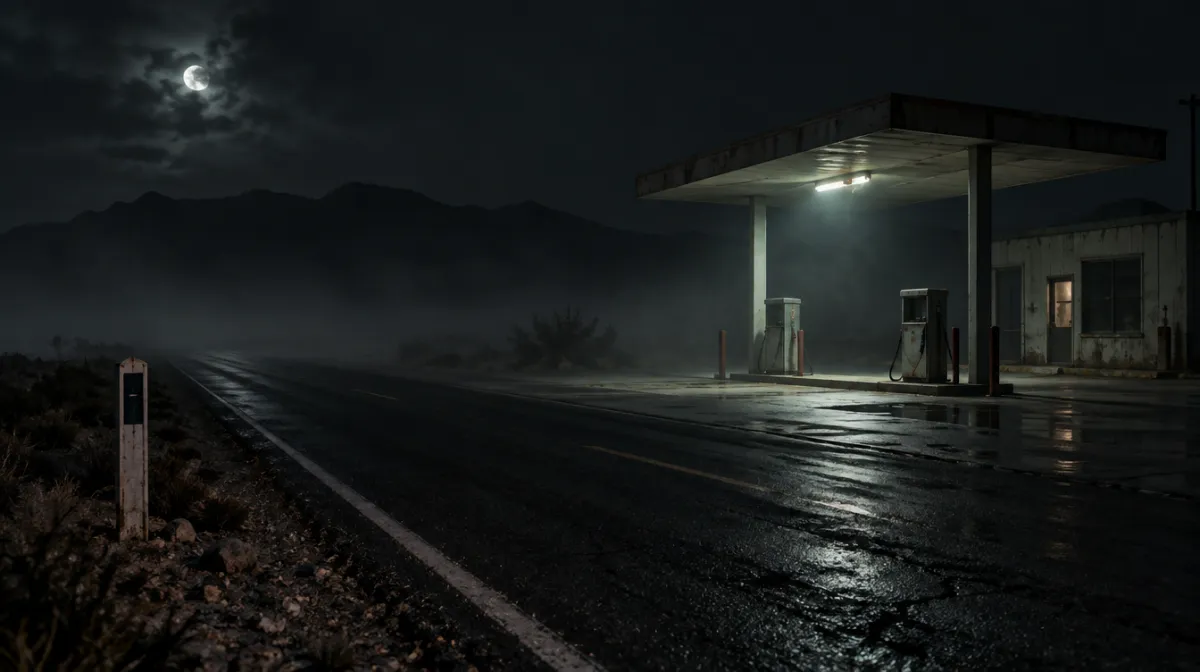
The ad said Night clerk wanted, Mile 49 Travel Stop, double pay, no experience needed. I needed the money more than I needed to ask why.
Mile 49 sits exactly halfway between Carver and nowhere: a canopy, four pumps, a store the size of a garage and one of the last working payphones in the state, bolted to the wall beside the ice machine. Ninety-eight miles of desert highway, and this is the only light.
Walt, the owner, trained me for a single evening. He showed me the register, the fuel override and the mop. At the end of the shift he handed me a yellowed index card in a plastic sleeve, the kind of thing you find taped inside a fuse box.
At 3:10 the payphone rings. Answer it. Say “Still here.” Hang up. Don’t miss it.
“Kids,” I said. “Prank calls.”
Walt didn’t smile. “Twenty-two years it’s rung. Every night, 3:10.”
“What happens if I don’t answer?”
He looked out past the pumps, to where headlights would come over the rise if there were any. “The girl before you didn’t,” he said, and that was all he would say.
The first week was easy. Truckers, a church bus, a couple arguing about a wrong turn, and long hours of nothing while the wind rattled the canopy. At 3:10 every night the payphone rang, a real metal bell, far too loud for the empty lot. I’d step into the cold, lift the heavy receiver and hear the same thing: an open line, like a long hallway. “Still here,” I’d say, and hang up.
Some nights I thought I heard breathing. Some nights I thought I heard traffic, a lot of it, very far away.
By the second week I had stopped being scared and started being curious. On the ninth night I stayed on the line.
“Still here,” I said. Then: “Who is this?”
The breathing stopped. A woman’s voice said, very close to my ear, “Is it still on? Is the light still on?” Then the line went dead.
The next afternoon I asked Walt about the girl before me. Her name was Marisol, he said. She worked three months. One night she fell asleep behind the counter.
“Missed the call by four minutes,” he said. “Truckers came in at dawn. Pumps on, register open, coffee still warm. No Marisol.”
“So she walked off. People quit.”
“Her car was still here,” Walt said. “Keys in it.”
I told myself people disappear on desert highways all the time. That’s what desert highways are for.
The night it happened, I was working a double. By three o’clock I was on the stool with my head on my arms and the hum of the drinks coolers wrapped around me like a blanket.
I woke to silence. Not quiet — silence. The coolers had stopped. The wind had stopped. The clock over the door said 3:14.
I ran outside. The payphone receiver was hanging on its cord, knocking softly against the wall. Beyond the canopy, the dark was wrong. The highway was still there, but the desert on either side had gone flat and grey and endless, as if someone had erased the world around the edges and never filled it back in.
Then the headlights came. One pair, then another, then dozens: cars cresting the rise from both directions, slow and patient, like people who had been driving for a very long time. They didn’t pass. They pulled into the lot and stopped at the very edge of the light, engines running, and the drivers stared at the canopy the way you stare at a campfire on a cold night.
At the front, in a small blue hatchback, sat a young woman with a Mile 49 name badge still pinned to her shirt.
Marisol wound down her window. “Did you answer?” Her voice was the voice from the phone.
“I missed it,” I said. “I fell asleep.”
She nodded as if she had known all along. “Then it’s looking for us now.” She pointed back up the highway. Beyond the last car, something was coming that had no headlights at all, just a darkness moving along the road, swallowing the white lines one by one.
“Call it back,” she said. “Tell it you’re still here. Before the light goes.”
The canopy lights were flickering. I grabbed the receiver. There was no dial tone, only that long-hallway sound, and far down the hallway, something breathing that was much bigger than a person.
“Still here,” I said. My voice cracked. “Still here. Still here.”
The lights steadied. Inside, the coolers shuddered back to life. When I looked up, the lot was empty: just the pumps, the moths and the wind.
I finished the shift. I still don’t know why. At dawn a trucker came in for coffee and asked if I was all right, because I was still holding the phone.
I work there now, full time. Double pay. I don’t sleep on shift anymore. I drink the terrible coffee, I watch the clock, and at 3:10 I answer on the first ring. Some nights I hear traffic on the line, a lot of it, very far away, and a young woman asking if the light is still on.
“Still here,” I tell her. I always tell her.
Walt retired last spring. He left me the card, with a new line written underneath in his careful capitals: DON’T TRY TO BRING THEM IN.
Last night, the mile marker outside said 50.
If this one stayed with you, try The Last Passenger or The Tenant next, or browse more creepy stories that feel true.

Every article is edited by a human and checked against our editorial policy. Spotted a mistake? Tell us.
Five original short scary stories to read at night, each under three minutes: a text from a lost number, a lagging reflection, snow angels and more.
Four original creepy stories told like real accounts: a trail camera, a thrift-store voicemail, a late-night delivery and a lost child. Plus why they feel real.
An original short horror story: on the last run of the night, a bus driver picks up a passenger at a stop that was removed years ago.